
Digital Transactability
The Digital Transactability data set goes a step further by providing incremental information about sellable, visible, eligible, and available transactable items actively sold on Walmart.com through any store fulfillment channel. This data is crucial for understanding how products perform in terms of their online transactability, ensuring that customers can add your items to their online baskets for Online Pickup & Delivery (OPD).
Key Features of the Digital Transactability Data Set:
Product Detail Page (PDP) Completeness: Helps ensure that the item’s product detail page is published and complete.
Safety and Compliance: Helps confirm that the item meets all safety, compliance, and store process requirements for being picked and fulfilled via OPD.
Inventory Availability: Helps verify that there is enough inventory on-hand at the store to fulfill orders.
Whenever any of these conditions are not met, the item becomes "non-transactable" for OPD orders, preventing customers from adding the item to OPD orders that Walmart is ultimately unable to fulfill.
What Is Digital Transactability?
There are 4 sets of criteria that go into ensuring an item is transactable on the Walmart app and Walmart.com:
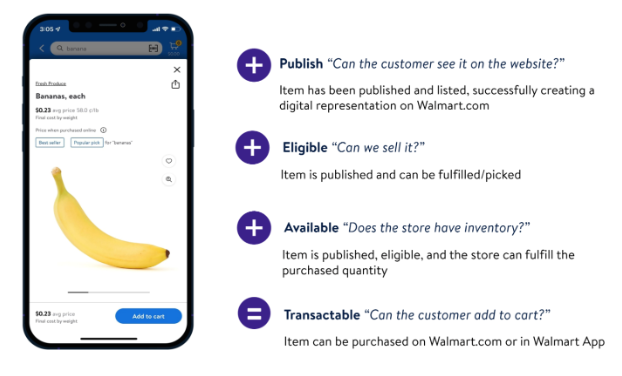
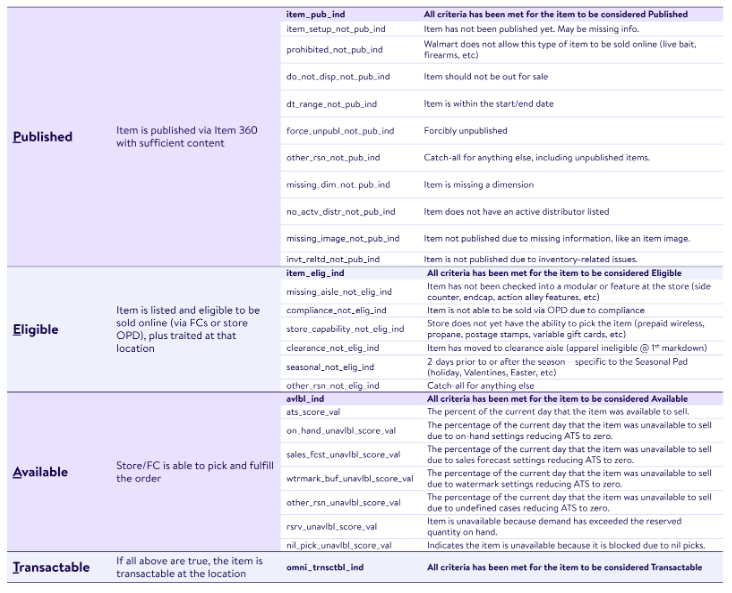
The item transactability flow PEAT can help you track your items in Channel Performance to ensure they are transactable:
Why Is Digital Transactability Important?
Understanding and improving Digital Transactability is crucial for suppliers. Here’s why:
Without ensuring digital transactability, suppliers risk their products being unavailable to customers, which can lead to several issues. These include:
Unpublished Items:
- Unavailable on Walmart.com
- Unavailable on the Walmart mobile app (e.g., in Store Search and Store Maps)
Published but Unavailable Items:
- Items may be substituted
- Possible loss of sale due to no inventory available
- Unfavorable customer experience
By understanding and improving Digital Transactability, suppliers can better ensure that their products remain available for online purchase, potentially enhancing sales and customer satisfaction.
Benefits of the Digital Transactability Data Set:
- Maximize Sales: By monitoring, researching, and improving digital transactability, suppliers can help maximize their sales across all channels.
- Customer Satisfaction: Helps ensure the "Perfect Order" – reaching for every OPD order being filled 100% on time and 100% in full, with 100% customer satisfaction.
- Actionable Insights: Provides insights on the items that customers add to their carts and purchase via OPD, helping suppliers make informed decisions and optimize their product offerings.
The Digital Transactability data set follows a daily (D-2*) refresh frequency, helping ensure that you have up-to-date information to maintain and improve product transactability.
By leveraging the Digital Transactability data set you may be able to enhance your product management strategies, drive sales, and ensure a seamless shopping experience for your customers on Walmart.com.
How to Use Digital Transactability Metrics
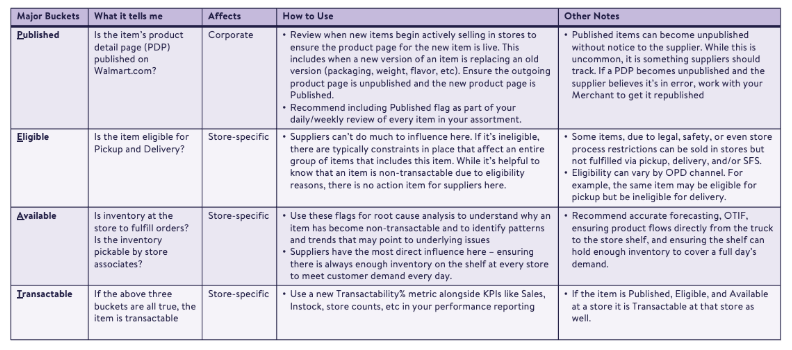
Digital Transactability metrics are grouped into 4 main buckets, abbreviated by the acronym P.E.A.T.
Deep Dive into Availability Score Metrics
While most Digital Transactability metrics are binary (1 or 0), the Availability metrics are scores between 0 and 100. At an item-store level, these scores help us understand what percentage of the day an item was available and at what point in the day the item became non-transactable due to non-availability.
ats_score_val
Primary Availability Metric. Percentage of the day the item was Available to Sell (ATS) at the store:
- ATS = 100: The item was transactable all day.
- ATS = 0: The item was not transactable at all that day, likely due to a carryover issue from the previous day.
- ATS between 1 and 99: Represents the percentage of the day the item was transactable. This is not always an exact calculation but provides a directional insight.
Example: An ATS Score of 93.42 suggests the item was transactable for approximately 93.42% of the day.
The corresponding score for Nil Pick Unavailable would be the difference between the ATS Score and 100 (i.e., 6.58%).
If ATS=100, the following scores will be 0. If ATS<100, one of these scores will show a value which tells you what caused the item to become non-transactable, as well as roughly the time of day at which it occurred.
on_hand_unavlbl_score_val
When On Hand inventory reaches zero, the item becomes non-transactable at the store. Key Points:
- Immediate Effect: The item cannot be sold once On Hand is zero.
- Causes:
- A single OPD order.
- An in-store purchase with multiple units.
- Overlapping timing of an OPD order and an in-store purchase.
These scenarios can cause On Hand to drop to zero without hitting the watermark buffer.
wtrmark_buf_unavlbl_score_val
Watermark Buffer Unavailable: The Watermark Buffer is an automatic store setting (usually 1 unit) ensuring inventory availability for in-store customers. Key Points:
- Purpose: Ensures there's at least one unit available for in-store purchases.
- Difference from Safety Stock:
- Watermark Buffer: Affects digital transactability, turning it off when the buffer is reached.
- Safety Stock: Influences order timing and inventory flow to the store.
The Watermark Buffer is not the same as safety stock; it specifically manages digital sales.
rsrv_unavlbl_score_val
On a given day, units ordered for OPD that haven't been picked are called Reservation Quantity. Key Points:
- Reservation Quantity: Units ordered but not yet picked for OPD.
- Non-Transactable Situations:
- Sometimes, more units are reserved than are available on hand.
- When this happens, the item becomes non-transactable at the store.
Despite safeguards, these situations can occasionally occur.
nil_pick_unavlbl_score_val
Nil Pick Unavailable. As soon as an item is nil picked, it becomes non-transactable at the store until the item has an in-store sale or the store receives another case of the item.
sales_fcst_unavlbl_score_val
Sales Forecast Unavailable. Item is missing a sales forecast.
other_rsn_unavlbl_score_val
Other Reason Unavailable. Other criteria can cause an item to be unavailable. These are rare and grouped together under a catch-all bucket.
Recommendations for Getting the Most Out of Digital Transactability
| DO | DON'T |
|---|---|
Focus on the things you can control/influence as a supplier:
| There are many Digital Transactability metrics provided to help you understand and explain the “why.” Focusing on the most actionable metrics can help you get the most out of Digital Transactability. |
Aggregate metrics from the item-store level to the corporate level using the four major indicators:
| It may not be necessary to aggregate every single metric. It can be beneficial to focus on aggregating the four major indicators and then use the other metrics as part of your root cause analysis research. For example, aggregating the Availability Indicator ( avlbl_ind) might show you that an item is transactable across 98.3% of stores. From here, you can dig into the other various Availability Score metrics to understand the drivers of the 1.7% stores that are unavailable. You may be able to attribute 1.5% of that 1.7% to availability issues, which can then point you toward deeper research into forecast accuracy, OTIF performance, and other instock drivers that you can address to improve your 98.3% availability over time. |
| Use the Availability Score metrics to help identify if there are common recurring causes of unavailability. Are you frequently hitting the watermark buffer, onhand, or reservation quantity thresholds? If so, that’s a good indicator that you could be underforecasting or not fulfilling orders on time and in full. Are you frequently getting nil picks despite having inventory on hand? If so, it could be a good opportunity to review your in-store flow, PDP product images, and modular. | It may not be as beneficial to try aggregating the Availability scores and trying to derive too much insight from those aggregate numbers. These scores tend to be most helpful at the individual item-store level but may become less usable when aggregated. For example, if one store becomes non-transactable late in the day and another store becomes non-transactable early in the day, the stores may show ATS of 93 and 13, respectively. Averaged together, this gives me an aggregate ATS of 53, which isn’t helpful for explaining what happened at either individual store, or even collectively (e.g., is it accurate to say that on average I was transactable for half the day (53%) in this example?) More useful would be a count that 2 stores became non-transactable in the course of the day. |
The "So What" of Digital Transactability
Digital Transactability provides suppliers with another valuable “health of the business” measure, indicating how available an item is for customers to purchase online. This metric is on par with familiar metrics like Repl Instock%, Pre-Substitution%, and On Shelf Availability (OSCA).
By dividing the number of Transactable Stores by the number of Traited Stores, suppliers can introduce Store Transactability% to their business reporting. Leveraging Digital Transactability data helps surface potential opportunities to dig deeper into non-transactability by identifying which items, stores, and reasons are driving non-transactability. Most of these issues will come down to PDP publication, Forecast, OTIF (On Time, In Full), in-store flow, and modular issues.
Since suppliers review Digital Transactability data 1 to 2 days after-the-fact, followed by a multiple-day lead time to address issues, it may be less useful to resolve individual item-store transactability issues as they occur. Instead, focus on using the data to identify underlying systemic root causes and address those to drive longer-term business health.
Conclusion
Understanding and leveraging Digital Transactability can be highly beneficial for suppliers aiming to optimize their online presence and sales on Walmart.com and the Walmart app. By focusing on the key metrics and criteria outlined in this document—Publish, Eligible, Available, and Transactable—suppliers may help ensure their products are consistently available and visible to customers. The deep dive into Availability Score Metrics can provide valuable insights into the daily availability of items, which may help identify and address the root causes of non-transactability.
Suppliers might find it advantageous to prioritize actionable metrics and focus on controllable factors such as product page completeness, forecast accuracy, and in-store inventory management. By doing so, they can drive improvements in their digital transactability, potentially enhancing customer satisfaction and sales performance. Regularly reviewing and analyzing these metrics may allow suppliers to identify patterns, trends, and common root causes, enabling them to make informed decisions that contribute to the long-term health of their business.
In summary, Digital Transactability serves as an important measure of an item's availability for online purchase. By continuously monitoring and optimizing these metrics, suppliers can help ensure their products remain accessible to customers, thus maintaining a strong competitive edge in the digital marketplace.
